15 November 2026
Opinion: History says the special votes will cost Luxon his majority. Our prediction: Opportunity chooses the next government
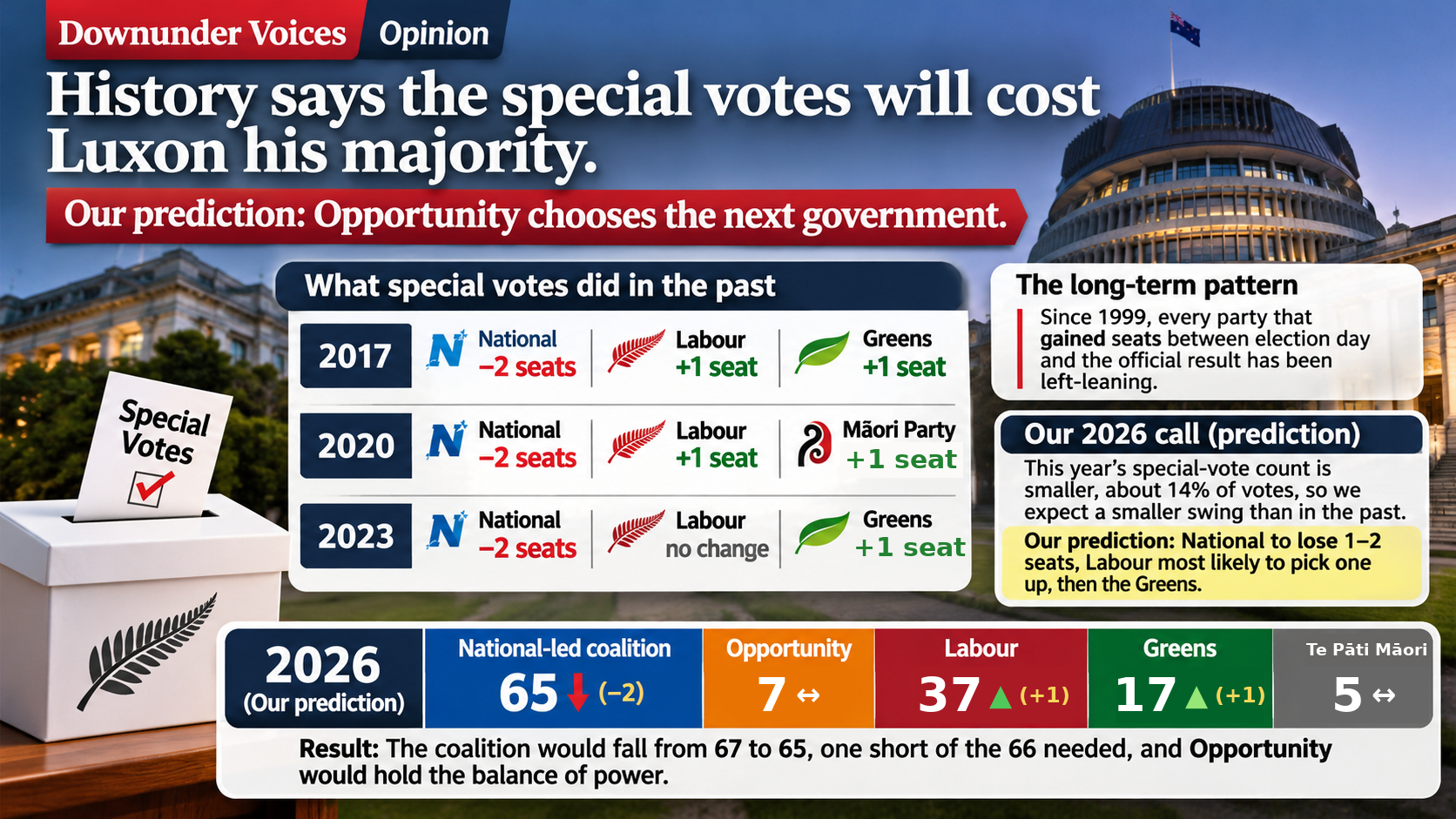
In 2017, 2020 and 2023 the special votes cost National two seats every time. Scaled to this year's smaller count, history points to the coalition falling from 67 seats to 65, one short of a majority, with Opportunity holding the balance of power.
Downunder Voices perspective
Full analysis
Eleven days before the official result, New Zealand is being told to wait and see. Downunder Voices will not sit on the fence. Here is our call: the special votes will take at least one seat, and more likely two, from National, ACT and NZ First. The coalition will fall below the 66 seats needed to govern, and the Opportunity Party will decide who leads the country.
Where things stand
On the Electoral Commission's preliminary count, Labour narrowly won the party vote, 29.36 per cent to National's 29.21 per cent, SBS reported. National, ACT and NZ First hold 67 seats in a 131-seat Parliament, one more than they need. About 399,000 special votes are still being counted, including about 96,000 from New Zealanders overseas. The official result is due on Friday 27 November.
What history tells us
Special votes are the votes cast by people overseas, people voting outside their electorate and people who enrolled late. They are counted after election night, and for more than 20 years they have moved in one direction. Since 1999, every party that has gained seats when the specials were added has been on the left, NZ Herald analysis found.
The last three elections show how steady the pattern is:
2017: about 420,000 special votes (16% of the total). National lost 2 seats. Labour and the Greens gained 1 each.
2020: about 505,000 special votes (17%). National lost 2 seats and fell from 26.8 to 25.6 per cent. Labour gained 1 and Te Pāti Māori gained 1.
2023: about 603,000 special votes (21%). National lost 2 seats, from 50 to 48, and slipped 0.9 percentage points. The Greens gained 1 and Te Pāti Māori gained 2. Labour's share did not move, while ACT and NZ First each lost 0.4 points. National and ACT lost the majority they appeared to have on election night, and had to bring in NZ First.
That is three elections in a row in which National lost exactly two seats, and three in a row in which the right bloc went backwards.
Our prediction for 2026
This year there are fewer specials: about 399,000, roughly 14 per cent of all votes, according to RNZ. That is about 30 per cent fewer than usual, because changes to the law mean same-day enrolments are no longer counted as special votes, The Spinoff noted. Fewer specials means a smaller swing.
So we have scaled history down to match. If 2026's specials lean the way they did in 2017, 2020 and 2023, but with only around two-thirds of the weight, National should drop between half a point and a point of the party vote and lose one or two seats. Labour, which narrowly won the party vote on election night, should stay ahead of National and is the most likely party to pick up a seat, with the Greens next.
Our call: the coalition falls from 67 seats to 65, one short of the 66 needed. Labour, the Greens, Te Pāti Māori and Opportunity would then hold 66.
RNZ's analysis spells out what that means. If the coalition loses one seat it sits on 66, just enough to govern. Lose two and it drops to 65, and the four other parties hold the majority.
The overseas vote matters here too. About 96,000 special votes came from New Zealanders overseas, SBS reported, many of them in Australia. Kiwis abroad have been part of the left-leaning special vote in every recent election, and we see no reason for that to change.
What happens next
Opportunity leader Qiulae Wong has said she will talk to National first, because it won the most seats, and will turn to Labour if those talks stall, 1News reported. Her five bottom lines include regulating lobbying and capping political donations, RNZ reported. Mr Luxon has said real negotiations will not start until the official result.
Our prediction is that the National talks stall. Mr Luxon ruled Opportunity out nineteen times during the campaign, according to Stuff, and a Stuff poll found 45 per cent of people now trust him less after his U-turn. ACT's David Seymour is already talking to him about the finance job, Stuff reported, and NZ First ruled Opportunity out during the campaign. A National-led deal would mean Ms Wong's young party sitting at the cabinet table with ACT and Winston Peters. That is a hard sell to her own voters.
Chris Hipkins, by contrast, was open to Opportunity before a single vote was cast, and met Ms Wong within days of the count. If the coalition falls to 65, we expect a Labour-led government with the Greens and Opportunity, relying on Te Pāti Māori for confidence and supply. It would be untidy. It would also reflect how New Zealanders actually voted: Labour first on the party vote, and a clear message that people want change on the cost of living.
The other side
Our prediction could be wrong, and the case against it is real. On the night, the coalition already had a majority without Opportunity, and Mr Luxon has said he does not need Ms Wong's support. If the specials move only one seat, he can govern as before. Ms Wong has also said Opportunity would drop its tax reform plans in return for concessions in talks with the centre-right, which makes a deal with National easier than it looked during the campaign. And a Labour-led government would need four parties to agree on every confidence vote, which critics warn would be unstable.
Those are fair points. But a one-seat majority built on a record overhang, with the left ahead on the party vote, is not a mandate. When the final count lands on 27 November, we expect the balance to tip, and Qiulae Wong to choose change.
This is an opinion column. The prediction is ours, based on the reporting listed below.
Sources: NZ Electoral Commission preliminary results; NZ Herald special-vote analysis (2020 and 2023) and official-result reports, 2020 and 2023; 1News and Newsroom, 3 November 2023; SBS, 8 November 2026; Reuters via The Star, 8 November 2026; RNZ, 8 November 2026; The Spinoff, 8 November 2026; 1News, 10 November 2026; RNZ, 9 November 2026; NZ Herald, 8 November 2026; Stuff, 12 and 14 November 2026; Wikipedia summary of Opportunity Party policy announcements, October 2026.
Graphic: Downunder Voices, using Electoral Commission results for 2017, 2020, 2023 and the 2026 election-night count. 2026 figures are our prediction.
About this report
This article contains independently written commentary and community perspective from Downunder Voices.
Join our community
Follow Downunder Voices
Join thousands of readers following news and community stories from Australia, New Zealand and the Pacific.


