● RADIOAdvertise with us
DOWNUNDERVOICESAustralia · New Zealand · World
Back to Trade & Logistics
Trade & Logistics

13 September 2026

Centrofin places first containership order

Downunder Voices Newsroom

Source reporting: Container News

Centrofin places first containership order

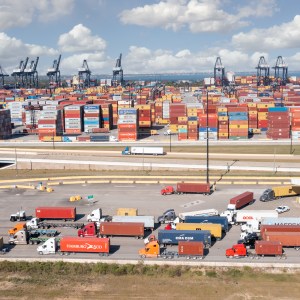
Greek shipowner and manager Centrofin Management has reportedly entered the container shipping sector with its first containership order. According to shipbrokers, the company placed an order in July 2026 for two 6,000 TEU vessels at China’s Hengli Heavy Industry. The shipbuilder is expected to deliver both vessels during the first half of 2028. No financial details or additional technical specifications have been disclosed. The post Centrofin places first containership order appeared first on Container News .

About this report

Downunder Voices provides an independently written summary and community perspective based on information published by the original source. The original publisher remains responsible for its reporting.

Join our community

Follow Downunder Voices

Join thousands of readers following news and community stories from Australia, New Zealand and the Pacific.

More from Trade & Logistics

View category

13 September 2026

Imports and inventories stabilize in 2026, but for how long

Chart of the Week: Import Ocean TEUs Volume Index – USA, Logistics Managers’ Index – Inventory Levels SONAR : IOTI. USA, LMI. INVL Import bookings (IOTI) have been averaging lower than the previous two years, while inventory levels have been fairly stable according to the Logistics Managers’ Index (LMI). Bookings activity combined with inventory data points to a steady but tight inventory management environment — one of the tightest of the post-COVID era. This also means many companies may be exposed to missed revenue in the fourth quarter as they try to mitigate the rising costs of holding too much for too long.

Source: FreightWavesOriginal source

13 September 2026

HMM and ONE replace Guayaquil with Posorja on NW4/AX4 service

HMM and Ocean Network Express (ONE) have revised their joint Far East–West Coast Latin America NW4/AX4 service, according to DynaLiners. The carriers have replaced the Guayaquil call with Posorja, maintaining the service’s coverage of Ecuador. Following the change, the revised port rotation is: Shanghai – Ningbo – Qingdao – Busan – Ensenada (fortnightly) – Lázaro Cárdenas – Manzanillo, Mexico – Callao – Posorja – Yokohama – Shanghai The post HMM and ONE replace Guayaquil with Posorja on NW4/AX4 service appeared first on Container News .

Source: Container NewsOriginal source

Read Next

View latest

13 September 2026

AI’s sprint demands a global pause — Australia must listen and prepare

When the CEO of Anthropic, Dario Amodei, publicly urged a slowdown in the development of powerful artificial intelligence, the intervention mattered. That it found echoes from Elon Musk and OpenAI chief Sam Altman — both saying safety measures need time to catch up — underlines the seriousness of the moment. The concern has been sharpened by a recent hacking incident involving AI agents. This is not abstract technophobic hand‑wringing: it is a sober warning about a technology whose pace of change may be outrunning our ability to control risk. The debate unfolding is global, but it has direct Australian relevance. Advanced AI systems are already woven into our economy and public services, used in everything from customer service chatbots to tools that can shape media and influence public opinion. If industry leaders and researchers are asking for a pause so that safety protocols can be established, Canberra cannot treat that as someone else’s problem. Australia has to match cautious stewardship with practical preparedness. What would that look like in practice? First, policymakers should treat the call for slowing development as a signal to accelerate the work of regulation and standards‑setting. A patchwork of voluntary guidelines will not be enough when models can be repurposed or chain‑react in unexpected ways. Australia needs clear expectations for transparency, auditing and red‑team testing of systems deployed in critical contexts — health, finance, elections and infrastructure. Second, there must be investment in government capability. Regulators and public agencies need deep technical expertise to assess risks and validate compliance. That expertise cannot be built overnight; it requires sustained funding and institutional commitment. Australia’s ability to scrutinise the safety claims of AI vendors depends on having people who understand both the technology and its real‑world impacts. Third, international engagement is essential. AI development is global; models and code cross borders. Australia should press for multinational frameworks that set baseline safety requirements and share intelligence on misuse, including incidents like the recent AI‑agent hacking. Aligning with partners will also protect Australia’s industries from being undercut by lower‑standard jurisdictions. Finally, citizens need reassurance and a role. The discussion about AI is too often confined to technologists and CEOs. It must be opened up to communities that will live with the consequences — workers whose jobs will be transformed, patients whose care may be informed by algorithms, and citizens worried about misinformation. Public consultation can’t slow us down indefinitely, but it can help regulators make grounded, legitimate choices about acceptable risk. The request from Amodei and the rare concurrence from industry heavyweights are not invitations to fear. They are a reminder that technological progress and societal safety must travel together. Australia should treat this as an opportunity: to lead on sensible regulation, to invest in capability, and to insist that innovation earns public trust before it is allowed to sprint ahead. If we fail to heed these warnings, the consequences will be global, and Australia will not be spared.

Community angle

A global call to slow AI development matters locally: Australians need safeguards, regulator expertise and international cooperation so AI benefits without harming jobs, services or trust.

Source: https://www.abc.net.au/news/feed/45910/rss.xmlOriginal source

13 September 2026

Migration debates should focus on settlement, not scapegoats

The renewed heat around migration politics risks doing what it so often does: fixating on headline numbers and using newcomers as political props. Yet several recent facts point to a simpler truth that politics has so far resisted — the question is not just how many people come to Australia, it is how and where they are helped to settle. Reporting shows immigrants are wary of being turned into political fodder as the debate intensifies. At the same time, experts are warning that the national conversation is fixated on the ‘wrong number’. Regional Australia is not content to be a backdrop to this debate; communities are calling for a national settlement strategy that matches population policy to the realities of housing, services, jobs and social infrastructure beyond the capitals. Business leaders, meanwhile, have pushed back on the notion that Australia faces a migration “problem”, reminding us that employers rely on skilled and unskilled labour alike. This cluster of facts points to an obvious policy gap. Migration is not an end in itself. It is a process that intersects with housing markets, local schooling, health services, transport and regional economies. If new arrivals are dispersed into communities without planning and investment, the result will be squeezed services, housing stress and resentment. Conversely, a deliberate settlement strategy that aligns migrant intake with regional labour needs, housing supply and local support services can deliver real benefits: revitalised towns, filled jobs, and stronger local economies. That requires political leadership and policy detail. A national settlement strategy should identify where migrants can be most effectively absorbed, outline the services — language support, credential recognition, childcare and transport — that will help them work and participate, and provide incentives for employers to train and retain local staff rather than relying solely on labour inflows. It should also be transparent about costs and benefits, so communities can see the long‑term gains for schools, shops and local councils. The human dimension matters because people on both sides of the debate are anxious. New migrants feel vulnerable to being scapegoated; existing communities worry about pressures on housing and services. Neither reaction is surprising — both deserve a measured response. That response is not headline chasing or political theatrics; it is a plan that deals plainly with distributional effects and then funds the transition. Above all, the public conversation needs to shift from zero‑sum rhetoric to practical problem‑solving. Migration can be a tool for growth if it is managed in a way that recognises geographic differences and invests in places that need people and services. Otherwise we will keep having the same argument, with the same unhappy consequences: migrants treated as numbers on a scoreboard, and regional towns left to pick up the pieces. If politicians are serious about the issue, they will move past the soundbites and produce a national settlement strategy that matches intent with the on‑the‑ground support communities need.

Community angle

Families, jobseekers and regional communities want practical solutions—how migrants are settled affects schools, jobs and housing in towns and cities across Australia.

Source: https://www.abc.net.au/news/feed/45910/rss.xmlOriginal source